
Even the best-designed floor is only as strong as its joints. GCS installs two specialised joint protection systems to extend floor life and reduce long-term maintenance.
Armour Joint
Armour joints are installed at designed construction joints. As concrete cures and shrinkage forces develop, the joint's plastic bolts shear to allow the steel profiles to open at a permitted opening — permitting minor, controlled slab movement from drying shrinkage and thermal variation, while restricting vertical displacement between slabs. Conforms to joint aris EN 10277-1:2018, shear studs to EN ISO 13918:2017, and Duraplate to EN 10025-2:2004; design referenced to TR-34.
Engineering Advantages
- Improves joint bearing strength (shear and bending)
- Resists twisting from wheeled traffic
- Efficiently transfers load between adjacent slabs via plate dowels
- Allows controlled horizontal movement while eliminating vertical movement between slabs
- Mitigates joint repairs, curling, and spalling
- Allows continuous pouring on both sides of the joint
Ideal Applications
- Industrial floors
- Warehouses and distribution centres
- Industrial storage facilities
- Roads and pavements
- Airports and runways
- Dockyards
Plate Dowel & Sleeve
When forklifts, MHE, and other machinery cross a joint, that joint must bear and transfer load between adjacent slabs without disturbing serviceability. Diamond or rectangular plate dowels increase the joint's shear strength, bending strength, and overall load capacity. Duraplate conforms to EN 10025-2:2004; material is ABS; design referenced to TR-34.
Engineering Advantages
- Load transfer across the joint
- Increased bending and shear strength
- Enhanced load-bearing capacity
- Minimises differential deflection between adjacent slabs
- Allows diagonal and perpendicular/parallel shrinkage movement
- Maximises surface area of the joint line
- Eliminates drilling or processing on formwork
- Reduces risk of restraint
- Speed and accuracy of dowel placement
- • TR34 4th Edition Code
- • ASTM E 1155 Levelness
- • DIN 18202 Precision
- • EN 10025-2 Duraplate
Key Benefits
- Improves joint bearing strength (shear and bending)
- Resists twisting from wheeled traffic
- Efficiently transfers load between adjacent slabs
- Allows controlled horizontal movement while eliminating vertical displacement
- Mitigates joint repairs, curling, and spalling
Target Facilities
- Industrial floors
- Warehouses and distribution centres
- Roads, pavements, and airports
- Dockyards
Armour Joints & Plate Dowel Systems
Even the most precise concrete slab is only as durable as its construction joints. Discover how GCS engineered joint protection systems prevent spalling, transfer heavy MHE loads, and eliminate differential deflection.
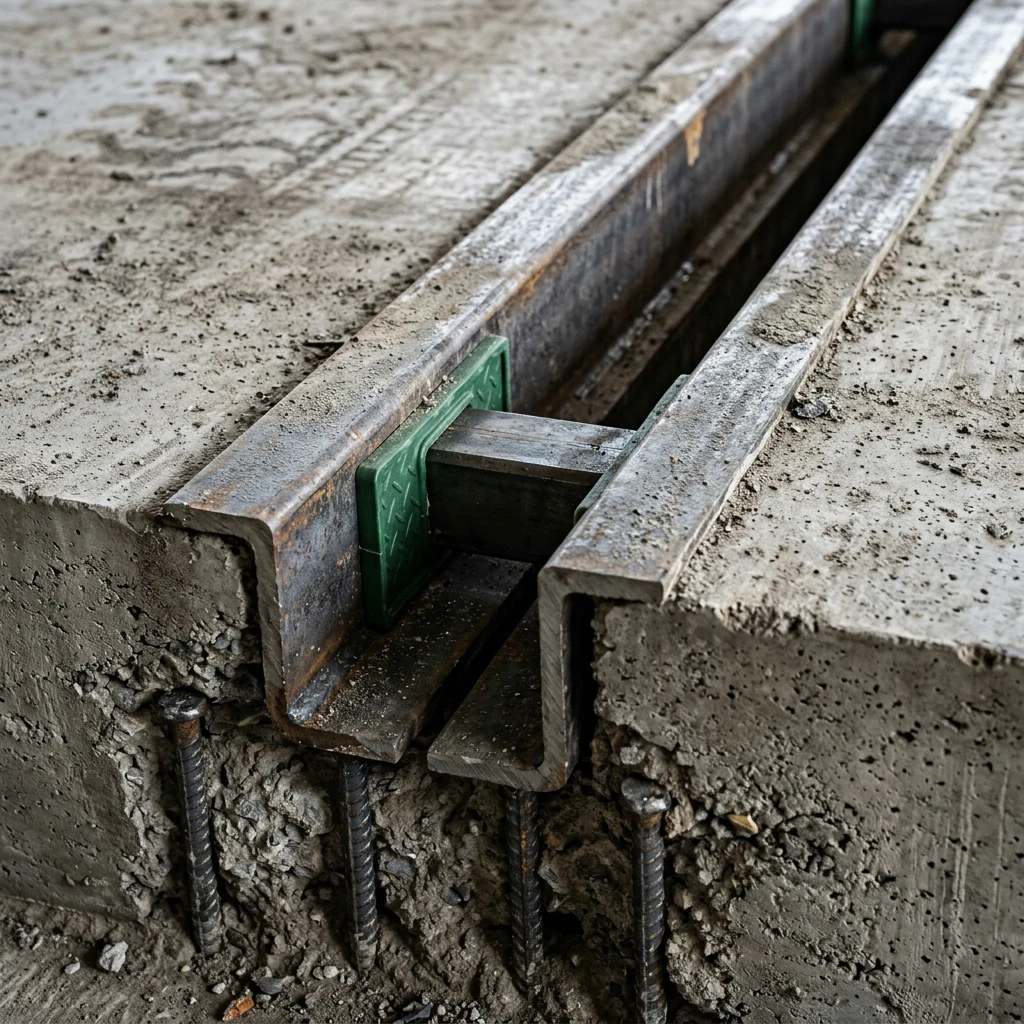
Heavy-Duty Steel Armour Joint
Material Specification: Cold-Drawn Steel Profiles & Shear Studs with Shearing Plastic Bolts
Armour joints are installed at designed construction joints. As drying shrinkage occurs during curing, plastic bolts shear, allowing heavy steel aris profiles to open safely without vertical displacement.
How It Works
Permits controlled horizontal slab movement from drying shrinkage and thermal expansion while locking vertical alignment, eliminating joint spalling under heavy wheel traffic.
Key Structural Advantages
- Improves joint bearing strength in shear and bending
- Resists severe twisting and impact from heavy forklift wheel traffic
- Transfers high loads efficiently between adjacent concrete slabs
- Allows continuous pouring on both sides of the construction joint
- Completely mitigates joint curling, spalling, and costly long-term repairs
Ready to Upgrade Your Floor Performance?
Discuss your site requirements with Gangadhar Concrete Solution. Our engineers provide full site surveys, TR34 tolerance matching, and custom quote estimations.
Request a Free Engineering Consultation